

During my carrier in modern flashy automotive industry I faced problem with noise reported almost before start of the production.
„I can hear irritating digital whistling noise each time lighning animation is going arround”
Lets describe our device under investigation
Linear light animations module, designed as more than 50 RGB LEDs. There is one master module providing animation schems, power and scallable group of slave execution blocks.
Lighning module is located in front of passengers at the bottom of front window what is nice audio amplification cavity faced toward recipient ears.
In this location modules are exposed for high temperatures, and had to operate at high brightness during the day to be nicely visible at sunlight.
Target location, product logevity and supported temperatures range eliminate usage of standard electrolythic capacitors forcing usage of more costly polymer ones resulting in tight decoupling along the line. All display pixels are time synchronized to provide fluent animation experience. To improve cost and power efficiency of LED drivers all slaves are powered at low regulated voltage by single Buck converter.
Product phase
Tests were performed and passed with few example clients animations in typical laboratory where a lot of equipment arround is working during business day so everyone tester was focused on main module function-light animations, heat, ESD, EMI etc.
Product final cost already fixed.
Suspects
Converter compensation network failure
Power converter compensation network failure in this particular sample causing converter oscillations and inductors magnetostriction.
Received sample measurement rejected instability hypothesis.
Magnetostriction
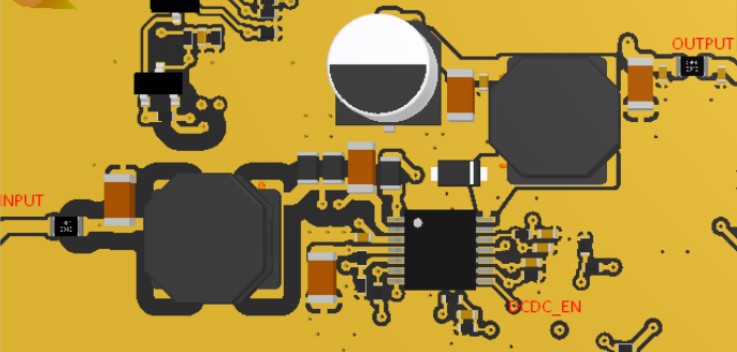
Here we have two identical inductors and low frequency ripple current is flowing throu them.
Flowing current causes magnetic material expansion and due to component reasonably big volume they are vibrating small PCB and this structure mounted only by clips on the board edge is working as speaker.
How to isolate which component is generating audible noise when they are close to each other ?
There is bone hearing mechanism! The simplest way is to place pencil tip at the suspected component top while other end touching human ear.
Big unexpected
Pointing arround PCB it is possible to identify that inductor magnetostriction has not so bad impact like ceramic capacitor on the front of Buck Converter!
Reasoning why?
Current at the input side of buck converter is much smaller than on the output. Theoretically it is supplied by car battery so voltage fluctuation should not be so high, right?
But, but wait!
Typicall automotive power supply front end has reverse polarity protection circuit followed by kind of noise filtering and DCDC converters as depicted below
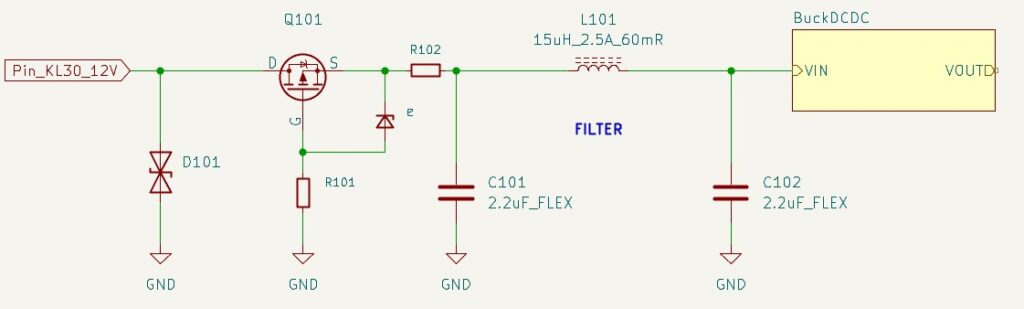
There is about 260mOhm of input series resistance on the board (Rds_on + Lr_dc). Inductor does not allow for rapid current changes. C102 is exposed to increased voltage ripple.
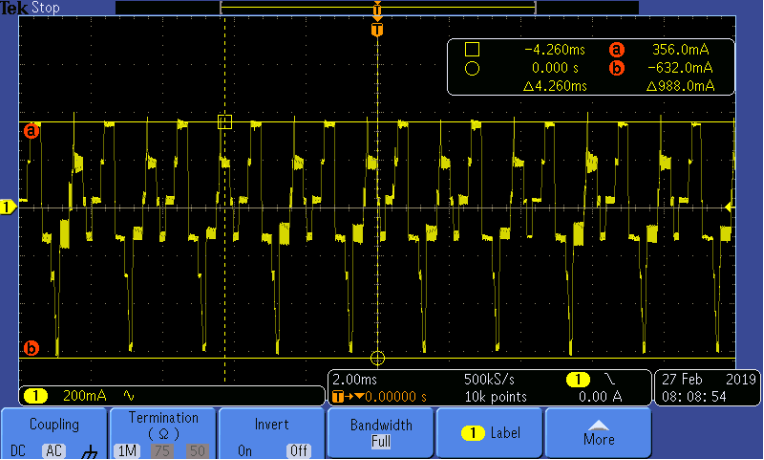
Depending on type of animation we can isolate high ripple component at 500Hz, 1KHz, 1.5kHz. Voltage ripple at C102 could reach 400mV peak-peak almost following shape of output current load.
Electrostriction
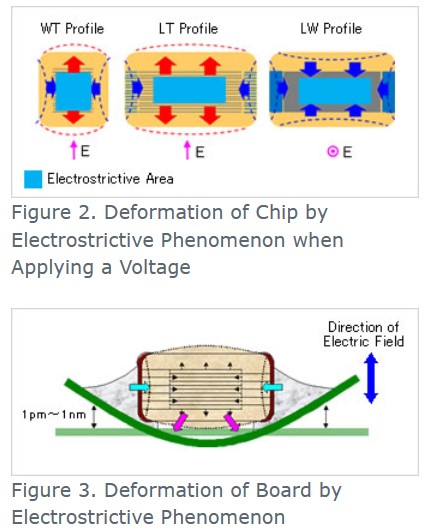
Multi-layer capacitors ceramic material shows mechanical deformation related with voltage ripple present at it. This ripple is transferred to the board and in some situations may be amplified by mechanical structures of board and housing.
Hearing abilities facts
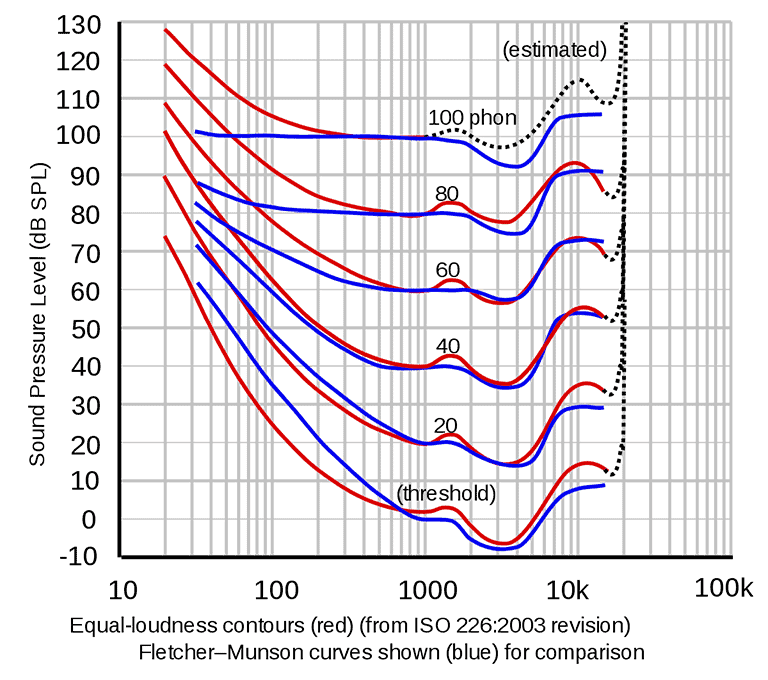
There exist equal loudness perception curves firstly created by Fletcher and Munson. They depict how much external sound pressure level is needed to be perceived by human ear with the same sound level.
We van see that 1kHz ~ 1.5kHz does not need so much energy to be perceived as loud. More over product location in cavity and angular shape amplifies small vibrations greatly.
How to solve this problem with minimal change to the system?
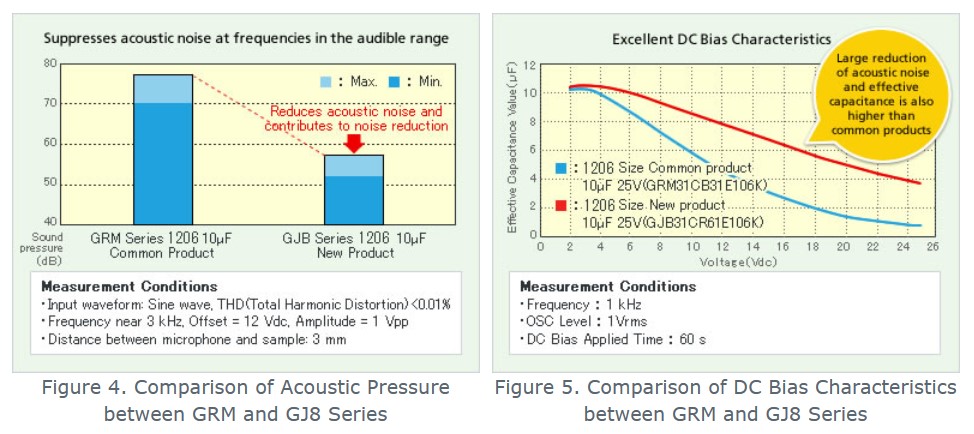
Fortunatelly at that time Murata offered dedicated capacitors with special ceramic compound for minimizing audible noise.
Own audible noise verification
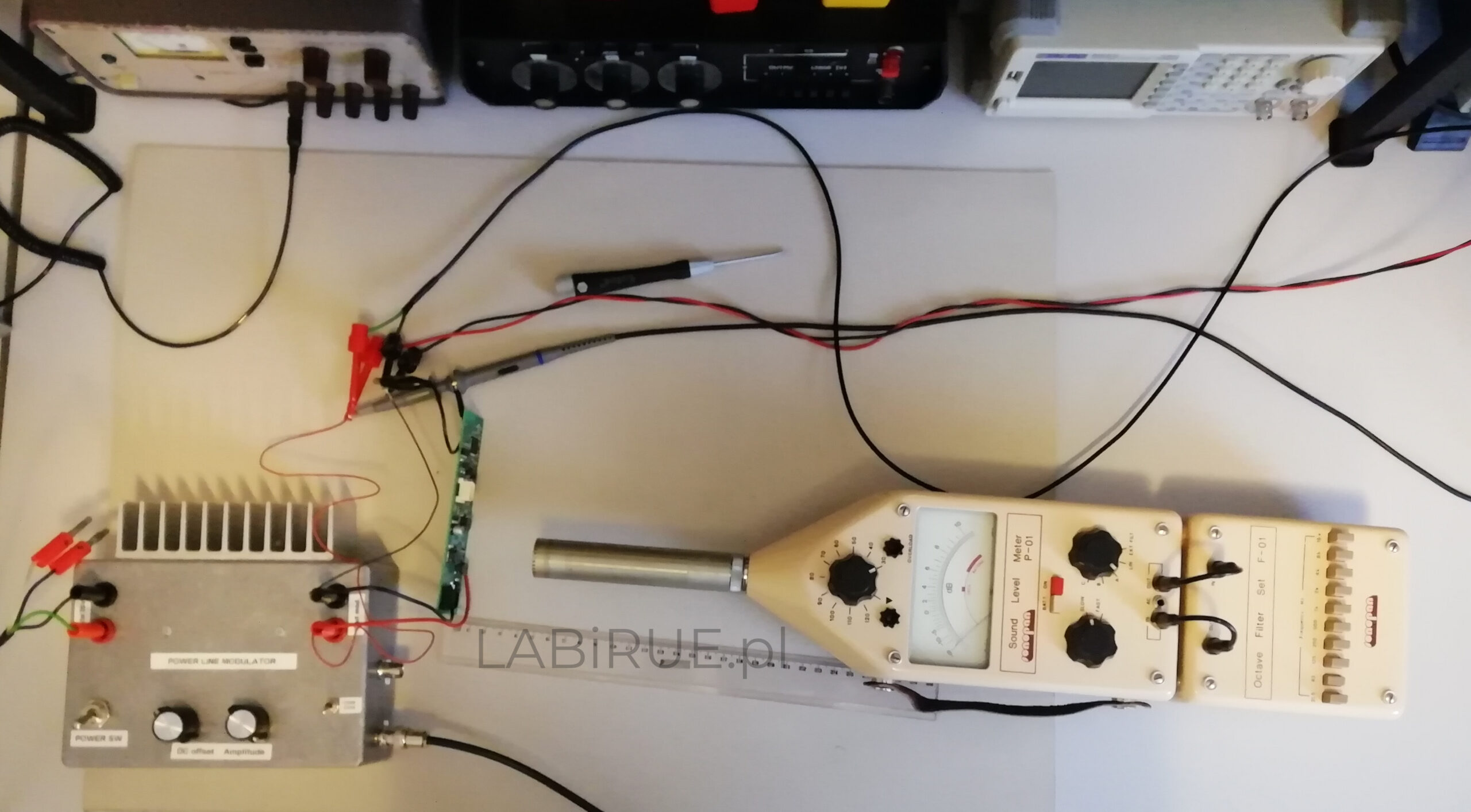
To qualify capacitors change, EMI filter has been powered by power amplifier stage controlled by sweep generator (article title image) to characterize sound level along different frequencies and to make visual comparison between typical automotive capacitors and noise mitigating ones.
With this simple component change we were able to lower generated noise slightly more than 10dB what satisfied our customer.